 Deep Learning
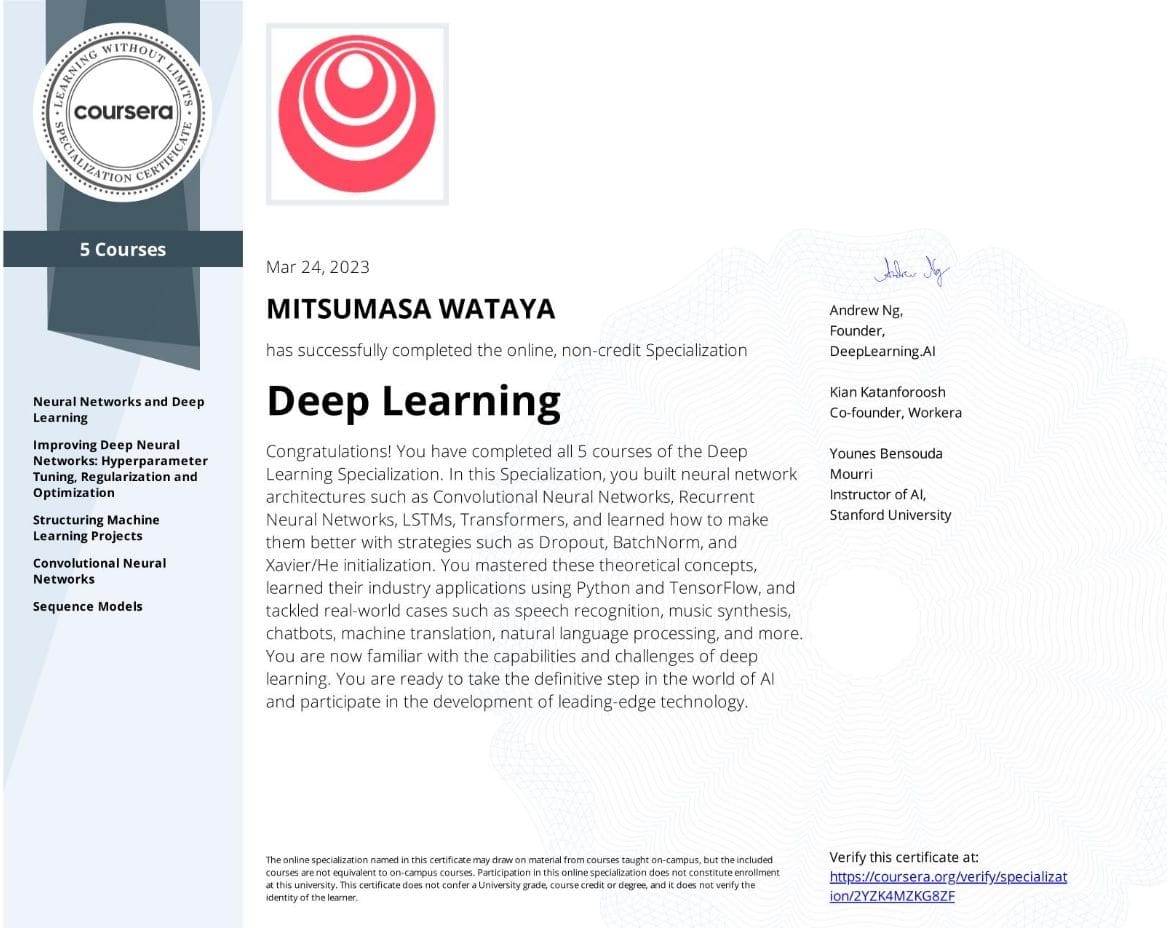
Course Completed
Neural Networks and Deep Learning Convolutional Neural Networks Sequence Models Improving Deep Neural Networks: Hyperparameter Tuning, Regularization and Optimization Structuring Machine Learning Projects
Description
Build and train deep neural networks, identify key architecture parameters, implement vectorized neural networks and deep learning to applications Train test sets, analyze variance for DL applications, use standard techniques and optimization algorithms, and build neural networks in TensorFlow Build a CNN and apply it to detection and recognition tasks, use neural style transfer to generate art, and apply algorithms to image and video data Build and train RNNs, work with NLP and Word Embeddings, and use HuggingFace tokenizers and transformer models to perform NER and Question Answering - Understand the significant technological trends driving deep learning development and where and how it’s applied. - Set up a machine learning problem with a neural network mindset and use vectorization to speed up your models. - Build a neural network with one hidden layer using forward propagation and backpropagation. - Understand the key computations underlying deep learning, use them to build and train deep neural networks, and apply them to computer vision. - Discover and experiment with various initialization methods, apply L2 regularization and dropout to avoid model overfitting, and use gradient checking to identify errors in a fraud detection model. - Develop your deep learning toolbox by adding more advanced optimizations, random mini-batching, and learning rate decay scheduling to speed up your models. - Explore TensorFlow, a deep learning framework that allows you to build neural networks quickly and easily and train a neural network on a TensorFlow dataset. - Use a machine learning flight simulator to learn how machine learning achieves human-level performance. - Become familiar with the concepts of end-to-end learning, transfer learning, and multi-task learning. - Implement the foundational layers of CNNs (pooling, convolutions) and stack them properly in a deep network to solve multi-class image classification problems. - Discover practical techniques and methods used in research papers to apply transfer learning to your own deep CNN. - Apply your knowledge of CNNs to computer vision: object detection and semantic segmentation using self-driving car datasets. - Discover how CNNs can be applied to multiple fields, including art generation and face recognition, and implement your own algorithm to generate art and recognize faces. - Discover recurrent neural networks (RNNs) and several of their variants, including LSTMs, GRUs and Bidirectional RNNs, all models that perform exceptionally well on temporal data. - Use word vector representations and embedding layers to train recurrent neural networks with an outstanding performance across a wide variety of applications, including sentiment analysis, named entity recognition, and neural machine translation. - Augment your sequence models using an attention mechanism, an algorithm that helps your model decide where to focus its attention given a sequence of inputs, explore speech recognition and how to deal with audio data, and improve your sequence models with the attention mechanism. - Build the transformer architecture and tackle natural language processing (NLP) tasks such as attention models, named entity recognition (NER) and Question Answering (QA). I completed this Professional Certificate, So, I can earn college credit if I admitted and enroll in one of the following online degree programs. - Illinois Tech, Master of Data Science