 Machine Learning
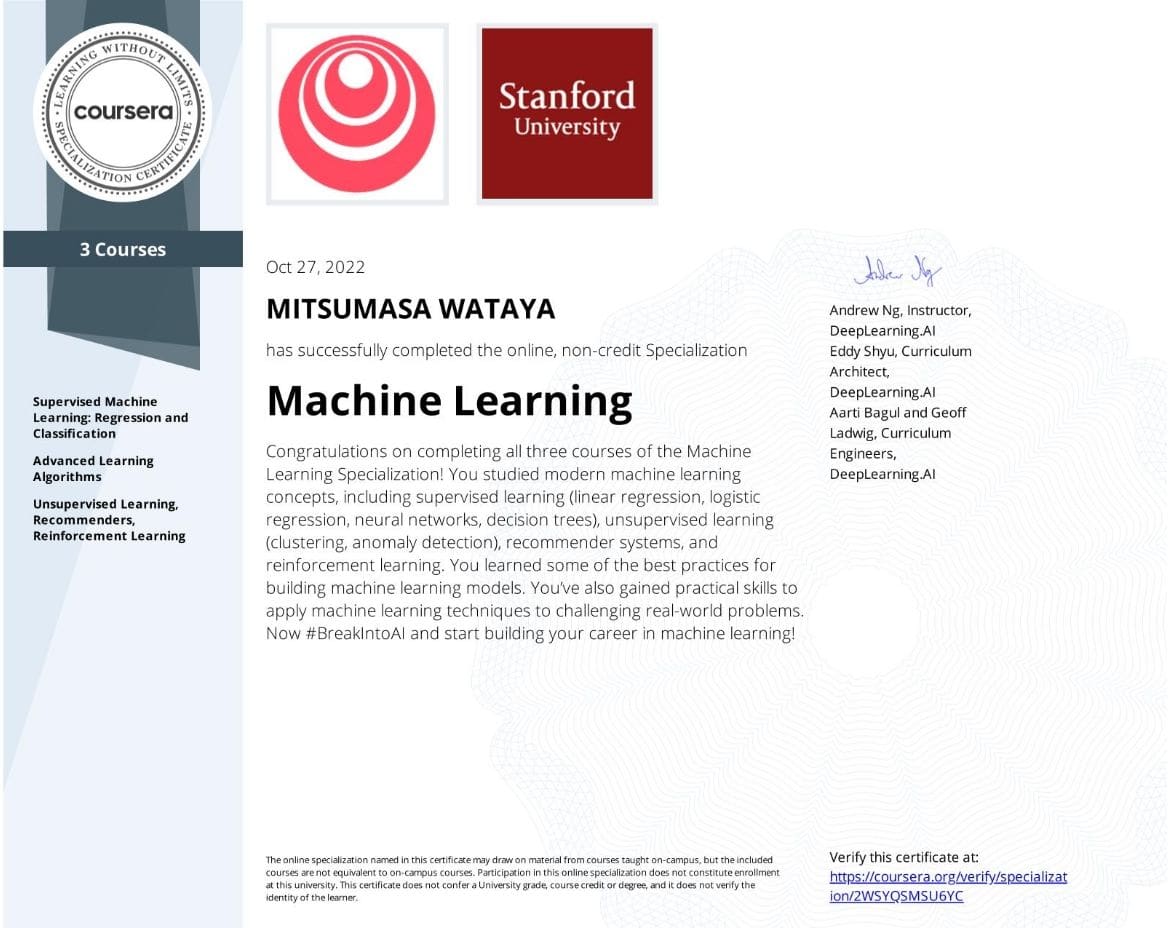
修了コース
Supervised Machine Learning: Regression and Classification Advanced Learning Algorithms Unsupervised Learning, Recommenders, Reinforcement Learning
説明
Build ML models with NumPy & scikit-learn, build & train supervised models for prediction & binary classification tasks (linear, logistic regression) Build & train a neural network with TensorFlow to perform multi-class classification, & build & use decision trees & tree ensemble methods Apply best practices for ML development & use unsupervised learning techniques for unsupervised learning including clustering & anomaly detection Build recommender systems with a collaborative filtering approach & a content-based deep learning method & build a deep reinforcement learning model - Learn the difference between supervised and unsupervised learning and regression and classification tasks. - Build a linear regression model. - Implement and understand the purpose of a cost function. - Implement and understand how gradient descent is used to train a machine learning model. - Build and train a regression model that takes multiple features as input (multiple linear regression). - Implement and understand the cost function and gradient descent for multiple linear regression. - Implement and understand methods for improving machine learning models by choosing the learning rate, plotting the learning curve, performing feature engineering, and applying polynomial regression. - Implement and understand the logistic regression model for classification. - Learn why logistic regression is better suited for classification tasks than the linear regression model is. - Implement and understand the cost function and gradient descent for logistic regression. - Understand the problem of “overfitting” and improve model performance using regularization. - Implement regularization to improve both regression and classification models. - Build and train a neural network with TensorFlow to perform multi-class classification. - Apply best practices for machine learning development so that your models generalize to data and tasks in the real world. - Build and use decision trees and tree ensemble methods, including random forests and boosted trees. - Gain a deeper understanding by implementing a neural network in Python from scratch. - Optionally learn how neural network computations are “vectorized” to use parallel processing for faster training and prediction. - Build a neural network to perform multi-class classification of handwritten digits in TensorFlow, using categorical cross-entropy loss functions and the softmax activation. - Learn where to use different activation functions (ReLu, linear, sigmoid, softmax) in a neural network, depending on the task you want your model to perform. - Use the advanced “Adam optimizer” to train your model more efficiently. - Discover the value of separating your data set into training, cross-validation, and test sets. - Choose from various versions of your model using a cross-validation dataset, and evaluate its ability to generalize to real-world data using a test dataset. - Use “learning curves” to determine if your model is experiencing high bias or high variance (or both), and learn which techniques to apply (regularization, adding more data, adding or removing input features) to improve your model’s performance. - Learn how the “bias-variance trade-off” is different in the age of deep learning, and apply Andrew Ng’s advice for handling bias and variance when training neural networks. - Learn to apply the “iterative loop” of machine learning development to train, evaluate, and tune your model. - Apply “data-centric AI” to not only tune your model but tune your data (using data synthesis or data augmentation) to improve your model’s performance. - Build decision trees and tree ensembles, such as random forest and XGBoost (boosted trees) to make predictions. - Learn when to use neural network or tree ensemble models for your task, as these are the two most commonly used supervised learning models in practice today. - Use unsupervised learning techniques for unsupervised learning: including clustering and anomaly detection. - Build a deep reinforcement learning model. - Implement K-mean clustering. - Implement anomaly detection. - Learn how to choose between supervised learning or anomaly detection to solve certain tasks. - Build a recommender system using collaborative filtering. - Build a recommender system using a content-based deep learning method. - Build a deep reinforcement learning model (Deep Q Network).